Summary

I am a postdoc at Mullard Space Science Laboratory, which hosts the Department of Space and Climate Physics at University College London. I work to understand exoplanet formation and evolution using young stars, exoplanet demographics, and binary star systems (and soemtimes even young binary star systems!). Papers I have either first- or co-authored are listed on ADS here.

My CV is here. My email is kendall.sullivan at ucl.ac.uk.

Research

I work on a variety of topics related to star and planet formation. My star formation interests include using simulations to improve the methods used to derive population-wide statistics in star-forming regions, and working to better understand the relationships between accretion, disk properties, and planetary system formation. My exoplanets work is primarily focused on understanding the impact of stellar properties (such as age and stellar multiplicity) on planet formation and evolution using exoplanet demographic studies.

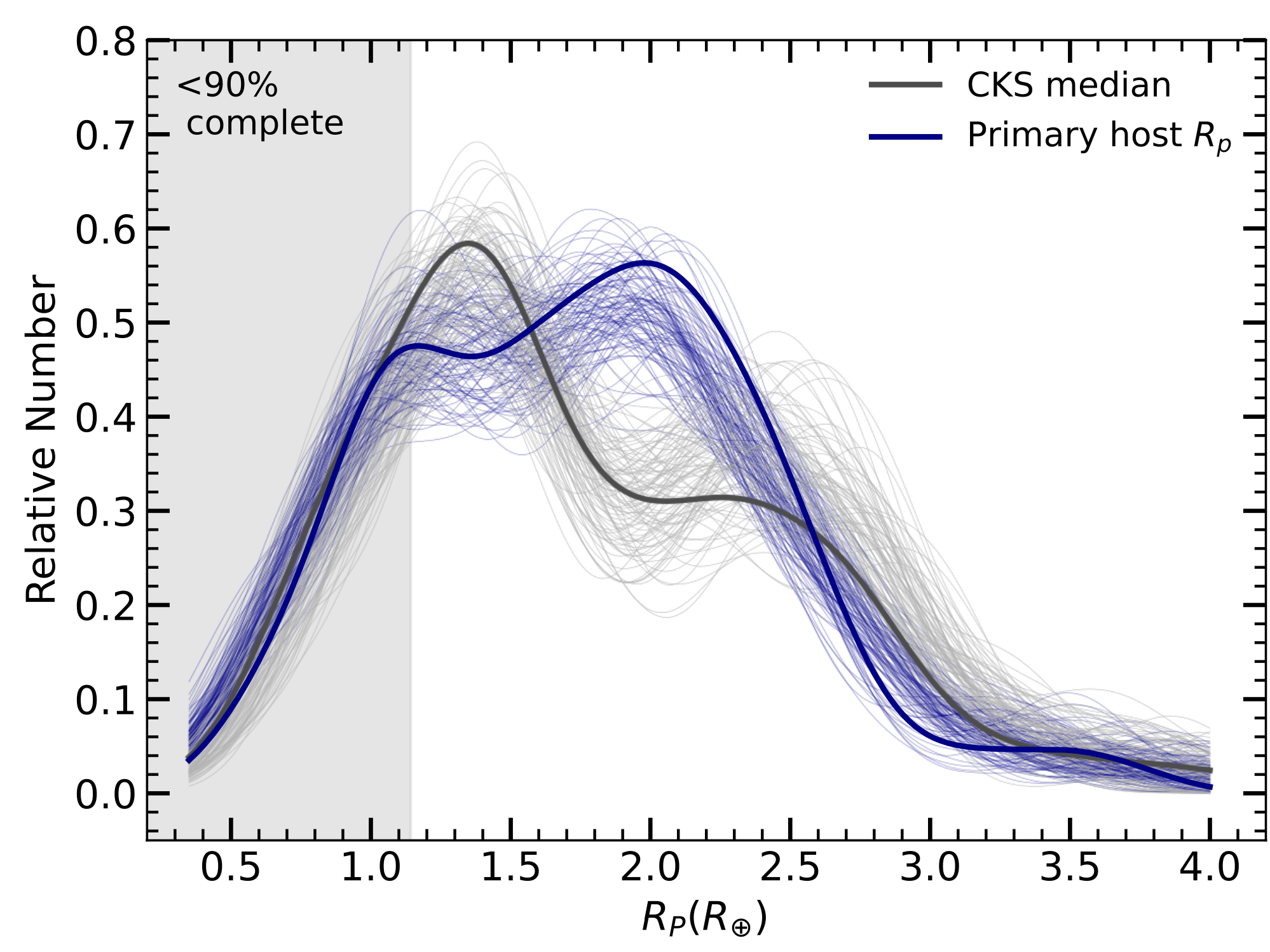
The revised radius distribution for a population of small circumstellar planets in binaries (blue) with comparable draws from the California Kepler Survey sample of small planets around single stars. The two distributions do not match, and we do not observe a radius gap in our sample. We think this is because the radius gap could be separation-dependent and thus blurred out in a sample with a wide range of physical separations (Sullivan et al. 2023)

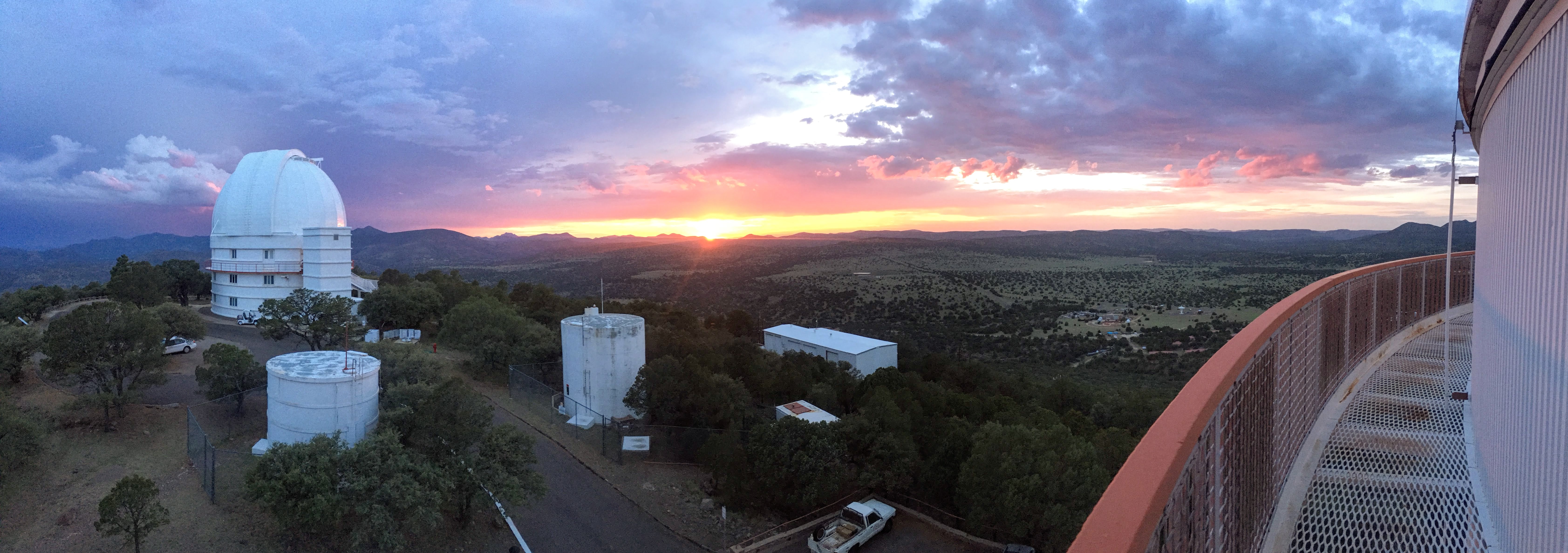
I developed a technique to retrieve the properties of spectroscopically-unresolved binary stars and am applying it to a variety of samples of planet-hosting binary stars from the Kepler mission. I began by analyzing archival data (Sullivan, Kraus, and Mann 2022), and have ongoing observational programs at the Hobby-Eberly Telescope at McDonald Observatory to collect data on a larger sample of Kepler binary star planet hosts. As a first scientific step, I published a paper that found that most supposed super-Earths in binaries are actually sub-Neptunes (Sullivan and Kraus 2022b).

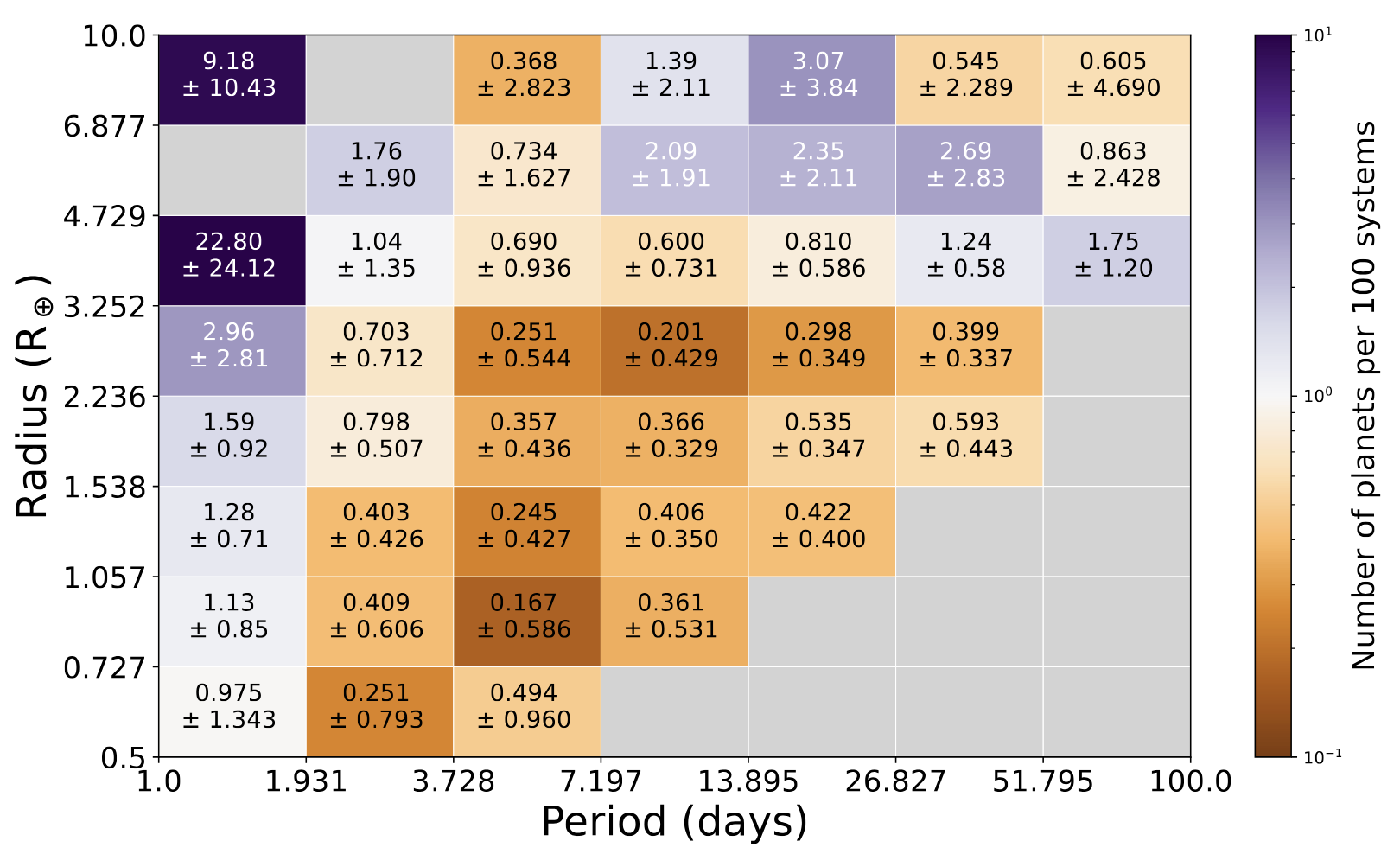
Next, we explored the population of small planets in or near the radius gap and in binary stars, where we did not detect the radius gap in a population of 120 small planets. We suggested that this is the result of the radius gap potentially having a separation-dependent location because of the impact of the secondary star on planet formation and evolution (Sullivan et al. 2023). Recently, we followed up this effort with a larger sample and found that the sub-Neptune population of planets is suppressed in close binaries, suggesting that binaries are indeed inhibiting large planet formation (Sullivan et al. 2024).

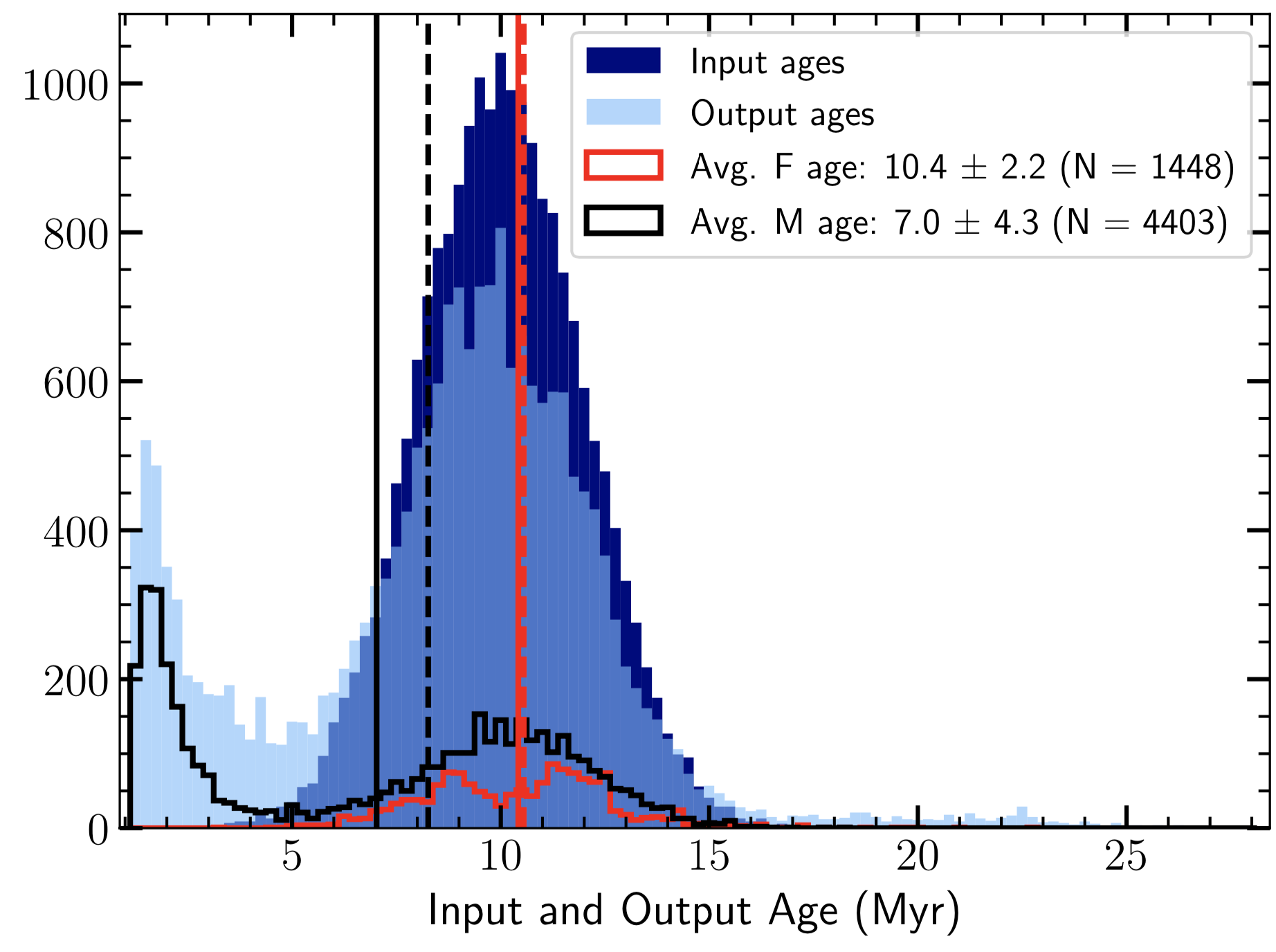
One way binary stars impact population statistics is by appearing younger than they truly are. (Sullivan and Kraus 2021)

Understanding Observational Biases

All studies have observational biases introduced by imperfect survey methods or true observational limitations. One way to better understand the impact of observational bias is by using synthetic surveys, where both the input ("true") and output ("observed") population parameters, such as age, binary fraction, and mass distribution, are known. I built a detailed, observationally-anchored population synthesis model to simulate and observe spectroscopic surveys of star-forming regions with different properties to try to understand whether some observed anomalous star-forming region properties could be caused by observational biases.

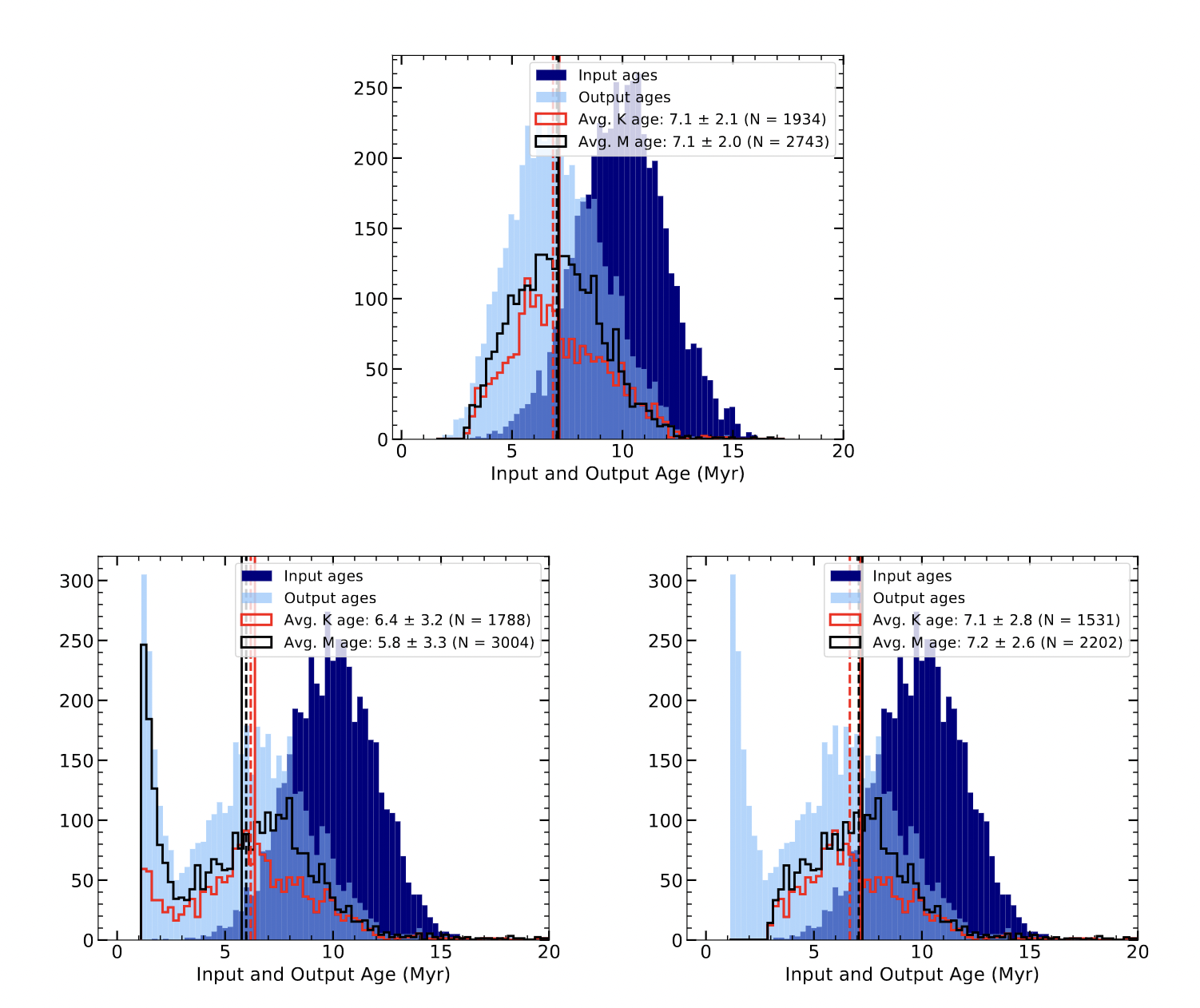
Starspots produce a uniform age gradient, rather than introducing an apparent age gradient as previously suggested in the literature (Sullivan & Kraus 2024).

Next, we added starspots into the simulation to investigate whether the presence of spots could introduce an apparent mass-dependent age gradient. Instead, we found that the starspots introduce a uniform age change, and that precise distances from the Gaia spacecraft can mitigate the impact of binaries on producing an apparent mass-dependent age gradient.

About

I received a B.S. double major in physics and astronomy from the University of Massachusetts, Amherst. While at UMass I studied blue compact dwarf galaxies and the magnetic fields of spiral galaxies, before beginning to work on young binary stars during an REU at Lowell Observatory in Flagstaff AZ with Lisa Prato. After graduating, I worked at Lowell for another six months before grad school. I received my PhD in astronomy from the University of Texas at Austin, where I worked with Adam Kraus to study the properties of young star-forming regions and binary stars that host exoplanets. Following grad school I was a postdoc at the University of California Santa Cruz, working with Natalie Batalha and continuing to study exoplanets in binary star systems to improve our understanding of planet formation. While at UCSC I calculated the first direct occurrence rates for Kepler planets in binary star systems. Currently, I'm a postdoc at UCL, working with Vincent Van Eylen on exoplanet demographics in single-star systems for the first time.

Outside of work, I like hanging out with my two cats, reading, finding new things to cook, and spending time outside.